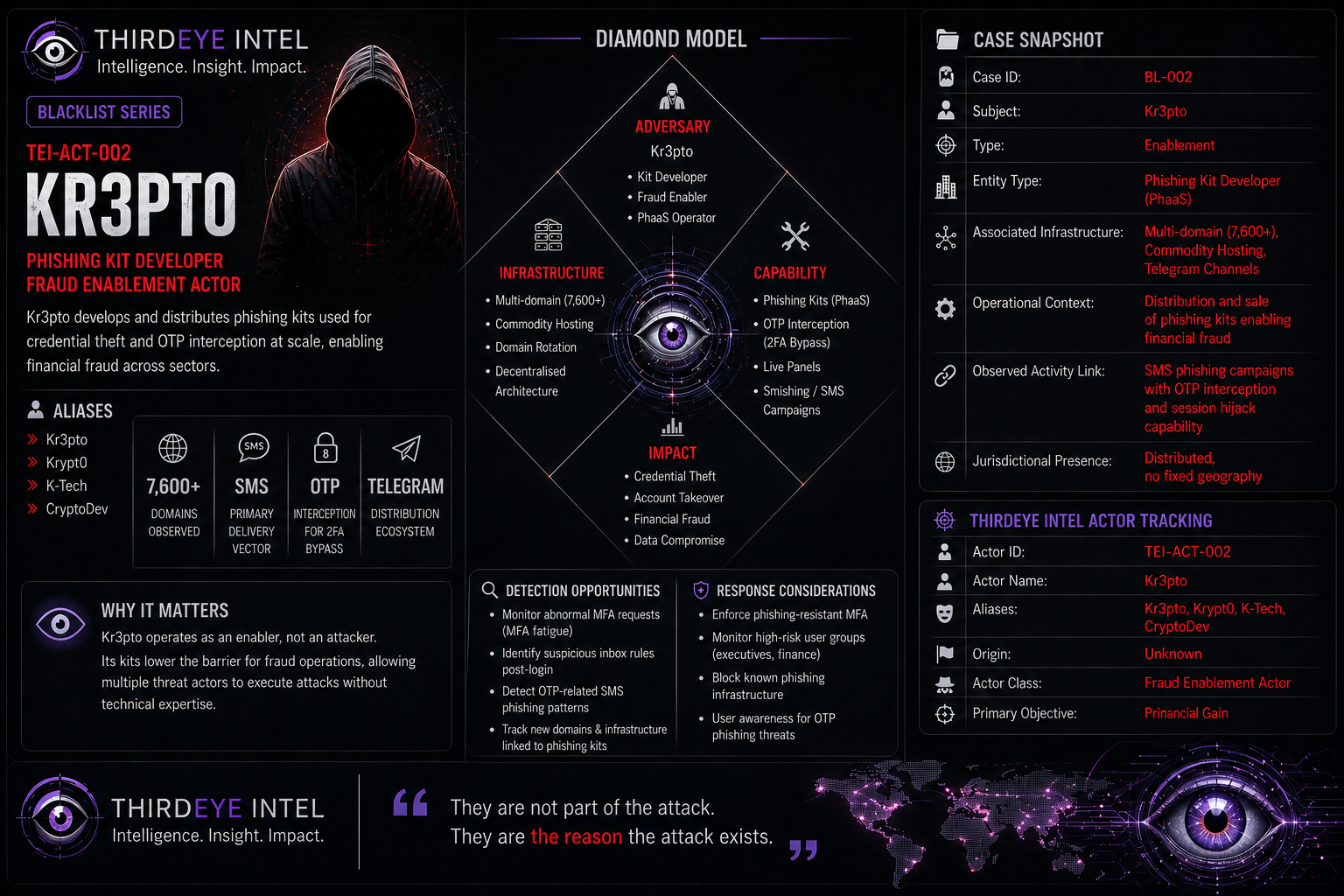
Operational Context: Distribution of phishing kits enabling banking, crypto, and identity fraud.
Observed Activity Link: SMS phishing with OTP interception and session hijack capability.
Jurisdictional Presence: Distributed, no fixed geography.
Executive Snapshot
Kr3pto is a well‑established phishing‑kit developer and distributor operating in the cyber‑crime ecosystem. Instead of selling on public forums, the actor uses private messaging channels such as Telegram to supply complete kits to low‑ and mid‑skill fraud operators. Akamai’s threat researchers report that Kr3pto’s kits were used in campaigns that deployed more than 7600 domains across eight UK banks, relying on commercial hosting providers for scale. These kits are tailored to each bank’s login flow and include modules for intercepting one‑time‑password (OTP) tokens, effectively bypassing two‑factor authentication (2FA). WMC Global further notes that distribution of the scams often happens via SMS lures, tricking victims into visiting the phishing site. Sophisticated kits like Kr3pto’s have raised alarms in the security industry because they allow real‑time OTP interception, and they remain effective partly due to manual intervention by operators during each login attempt.
Actor Overview
Kr3pto appears to be a single developer or small group that focuses on phishing‑as‑a‑service. Their main products are high‑fidelity banking phishing kits that closely mimic legitimate login portals and include back‑end panels for managing victims’ sessions. Unlike commodity kits circulating on underground forums, Kr3pto keeps distribution within closed communities. The kits are continually updated and are localised for specific banks, making them attractive to criminals targeting customers of UK and global financial institutions.
Key attributes:
Developer & distributor: Kr3pto builds and packages the kits and sells them to buyers. They do not run large‑scale campaigns directly; instead they enable others.
Private distribution: Sales are conducted through Telegram channels and potentially through the Ton anonymous network. The screenshot provided by the user shows multiple Telegram handles (e.g., @Kr3ptoV3, @Kr3pto, @Kr3ptoV2) and a session identifier, suggesting an emphasis on anonymity.
Multi‑channel delivery: Kits are designed for smishing (SMS phishing) and voice‑phishing using an automated “Kall Bot”. Victims receive an SMS linking to the kit and may later be contacted by a robocall to pressure them into completing the authentication process. There is not direct evidence that Kall Bot is used by the actor.
Global target scope: While initial reports concentrated on UK banks, the product catalogue (exfiltrated from Kr3pto’s site) shows kits for banks, telecoms, postal services and government portals across Europe, Australia, New Zealand, North America and other regions.
Operating Model
Kr3pto operates a phishing‑as‑a‑service ecosystem rather than a single campaign. The workflow is illustrated below and aligns with the Threat‑to‑Money Movement (TTMM) model used in fraud analysis.
Distribution to buyers: Kr3pto markets kits via Telegram and private channels. Buyers are predominantly low‑ to mid‑skill fraud actors who lack the expertise to develop their own kits but can run campaigns.
Deployment of infrastructure: Buyers register domains (often via inexpensive registrars) and host the phishing kit on commercial hosting services. Akamai researchers observed more than 7600 domains across eight UK banks; the high domain churn helps avoid blacklisting.
Victim acquisition (smishing): Campaign operators send SMS messages claiming a suspicious payee has been added to the victim’s account and instruct the recipient to click a link. The high open‑rate of SMS (around 98 %) makes smishing effective.
Credential and OTP capture: The landing page mimics the bank’s login. When victims enter credentials, the back‑end triggers a genuine login attempt to the bank and prompts for the OTP. Once the victim submits the OTP, the attacker can bypass 2FA. F5 researchers warn that kits like Kr3pto enable real‑time OTP interception.
Account takeover and monetisation: Operators log into the account and transfer funds to mule networks or conduct fraudulent transactions. Manual involvement is still required in many kits.
Infrastructure and TTPs
Commodity hosting & domain rotation: The large number of domains and use of multiple Autonomous System Numbers (ASNs) indicate decentralised hosting. This makes take‑down efforts resource‑intensive.
Adaptive kit design: Kr3pto’s admin panels allow operators to customise the phishing flow to match each bank’s authentication steps. The kits also collect device identifiers (user‑agent, IP address) to bypass fraud‑detection controls.
Manual 2FA bypass: Research shows that some Kr3pto kits require an operator to manually trigger the bank’s 2FA challenge and input the victim’s OTP. This human‑in‑the‑loop approach increases success rates but limits scale.
Cross‑channel amplification: After obtaining credentials, operators may use Kall Bot to make robocalls to victims, exploiting social engineering pressure to overcome hesitations.
Product Catalogue and Global Reach
The product list extracted from Kr3pto’s site reveals kits for diverse sectors and geographies. The table below summarises some of the categories. (Only short phrases are used in the table; examples are illustrative, not exhaustive.)
Category
Examples
Observations
Banking & Finance
UK banks (HSBC, Lloyds, TSB); Australian banks (ANZ, Westpac); US banks (Bank of America, Chase); Irish banks (AIB, BOI); European banks (Santander, BBVA)
Majority of kits target financial institutions, indicating high value for account takeover. Kits are localised to each bank’s branding and login flow.
Telecommunications & Utilities
Telcos such as Optus, Vodafone, AT&T; utilities like Origin Energy and ENEL; postal services (AusPost, SwissPost, Deutsche Post)
Targeting telcos enables SIM‑swap or account takeover fraud; postal and courier scams are used for lures (parcel delivery fees).
Access to government portals allows identity theft and fraudulent benefit claims.
E‑commerce & Subscriptions
Amazon, PayPal, Netflix/Binge, Uber
Compromised accounts are resold or used for purchases and gift‑card fraud.
Crypto & Exchanges
Binance, Coinbase, Kraken, CoinSpot
Live panels for crypto exchanges suggest capability to intercept two‑factor tokens during cryptocurrency withdrawals.
Corporate & SaaS
Salesforce/Okta, Apple ID, Gmail, Keeper Security
Indicates expansion beyond consumer banking into enterprise credential theft.
This breadth illustrates how Kr3pto monetises its kit engine across industries and geographies. The presence of live panels for crypto exchanges and SaaS logins suggests more advanced packages that handle dynamic authentication flows.
Entity Relationships
Kr3pto’s ecosystem involves multiple actor types. The diagram below depicts the relationships between the developer, buyers, infrastructure, tooling, victims and money‑mule networks.
Key relationships:
Kr3pto → Buyers: The developer sells phishing kits to low‑ and mid‑skill operators.
Buyers → Infrastructure: Operators register domains and host the kits on commodity servers.
Buyers → Comms channels: Sales and support are conducted via Telegram and possibly other encrypted channels.
Buyers → Tooling: Operators use the kit, OTP interception module and Kall Bot to run campaigns.
Tooling → Victims: Kits harvest credentials and OTPs from unsuspecting victims.
Victims → Financial layer: Compromised accounts are drained or used for fraud via money‑mule networks.
Fraud Kill Chain (TTMM) Map
The following diagram shows the high‑level kill chain from initial contact to monetisation. It aligns with the Threat‑to‑Money Movement model used by ThirdEye.
Smishing: Attackers send SMS messages with a plausible lure (e.g., payee alert). Victims click the link.
Credential capture: Phishing page collects username and password.
OTP interception: Kit or operator triggers a genuine 2FA challenge and captures the OTP.
Account takeover: With credentials and OTP, attackers log into the victim’s bank or service account.
Fraud & money movement: Funds are transferred to mule accounts, or the account is used for purchases or money laundering.
Why Kr3pto Persists
Several factors explain Kr3pto’s longevity despite increased awareness:
Decentralised operation: The actor avoids a single point of failure by distributing kits to multiple buyers and having them host their own domains. Takedowns only disrupt individual campaigns.
Commodity infrastructure: Using cheap hosting services and rapid domain registration hides kits among legitimate traffic and makes enforcement reactive.
Adaptive kit design: Admin panels customise the flow to each bank’s authentication process. This increases success rates and makes generic detections harder.
Manual 2FA bypass: Operators actively handle the OTP interception phase, reducing reliance on automated bots and avoiding detection.
Cross‑channel lures: Combining SMS and voice phishing widens the attack surface and complicates defence.
Low barrier to entry for buyers: Buyers only need to purchase the kit and follow instructions; they do not require deep technical skills.
Control Layer
The phishing kit does not rely on exploiting infrastructure weaknesses first. It exploits user behaviour, trust boundaries, and authentication workflows. That distinction is critical. Traditional controls focus on:
Email filtering
Domain blocking
Endpoint protection
Kr3pto operates outside all three. Which means detection must shift to: Identity behaviour, customer interaction, and deception-driven telemetry.
1. Customer-Side Telemetry – Mobile SDK Controls
Control Objective
Detect compromised authentication flows by instrumenting user interaction and session behaviour on the mobile device.
Identify phishing campaigns by detecting shared infrastructure and kit behaviour.
Telemetry Requirements
Data Element
Description
Source
TLS Fingerprint
Certificate / JA3 hash
Network telemetry
Page Structure
HTML DOM patterns
Web analysis
Script Hash
JavaScript fingerprint
Content analysis
API Behaviour
Backend request pattern
Traffic logs
Detection Logic
Scenario
Detection Condition
Rule
Example
TLS Reuse
Same fingerprint across domains
Match JA3 hash
Multiple domains share TLS
Template Reuse
Identical HTML structure
DOM similarity > 90%
Same phishing page
Script Reuse
Matching JS hash
Hash match
Same credential capture logic
Backend Correlation
Shared API endpoints
URL pattern match
Same panel backend
Control Actions
Trigger
Action
Outcome
Pattern match
Block all related domains
Stop campaign
Infrastructure cluster
Expand detection scope
Reduce dwell time
Repeat detection
Update detection signatures
Increase coverage
4. OTP Abuse Detection – Identity Layer Control
Control Objective
Detect misuse of OTP during authentication.
Detection Logic
Scenario
Detection Condition
Threshold
Method
Context Mismatch
OTP requested vs used location differs
ASN mismatch
Compare network data
Rapid Usage
OTP used immediately
< 5 seconds
Timestamp comparison
Excess Attempts
Multiple OTP retries
> 3 attempts
Count attempts
Device Change
Device differs mid-session
Any change
Compare device ID
Control Actions
Trigger
Action
Outcome
Context mismatch
Force re-authentication
Break attack flow
Rapid usage
Delay transaction
Disrupt fraud
Excess attempts
Lock session
Prevent brute force
Device change
Step-up authentication
Validate user
5. SMS Intelligence Integration
Control Objective
Detect smishing campaigns before scale.
Telemetry Requirements
Data Element
Description
Source
Sender Number
SMS origin
Telecom provider
Message Content
Text body
SMS logs
Delivery Volume
Frequency
Telecom data
User Reports
Customer complaints
Support channels
Detection Logic
Scenario
Detection Condition
Rule
Example
Sender Reuse
Same number across campaigns
Pattern match
Repeated sender
Content Match
Known phishing keywords
Keyword detection
“Verify account”
Volume Spike
Sudden increase in messages
> baseline threshold
Campaign launch
Correlation
SMS + login events
Time correlation
SMS followed by login
Control Actions
Trigger
Action
Outcome
Campaign detected
Alert SOC
Early response
Sender identified
Block number
Reduce spread
Correlation confirmed
Link to auth logs
Validate attack
6. Deception as Intelligence
Control Objective
Use controlled environments to capture attacker behaviour.
Deployment Requirements
Component
Description
Implementation
Fake Accounts
Controlled identities
Create in system
Instrumented Endpoints
Monitored login flows
Deploy tracking
Interaction Logging
Session capture
Store behaviour
Controlled Exposure
Limited attacker visibility
Seed selectively
Detection Logic
Scenario
Detection Condition
Rule
Outcome
Fake credential use
Login attempt
Any use
Alert
Behaviour tracking
Session actions
Capture sequence
Profile attacker
Infra mapping
Source metadata
Log IP/ASN
Identify infra
Control Actions
Trigger
Action
Outcome
Interaction detected
Monitor session
Collect intel
Pattern identified
Update detections
Improve SOC
Infrastructure mapped
Block cluster
Disrupt ecosystem
🔥 Final Operational Insight
Condition
Impact
Required Shift
Phishing occurs outside enterprise
Limited visibility
Extend detection to customer layer
Authentication occurs inside
Control opportunity
Instrument identity flows
Fraud completes at transaction stage
High risk
Intervene before execution
Conclusion
Kr3pto exemplifies the modern phishing‑as‑a‑service model. By combining closed‑channel distribution, adaptive kit design and manual OTP interception, the actor enables less‑skilled criminals to bypass MFA and commit financial fraud at scale. The wide range of targeted brands and the international product catalogue underscore the threat’s global reach. To counter Kr3pto and similar actors, organisations must look beyond email‑centric controls, correlate signals across SMS and voice channels, and share intelligence promptly. ThirdEye’s analysis highlights the operational mechanisms, relationships and kill chain, providing a foundation for defenders and law enforcement to disrupt this ongoing threat.